Encounter of two worlds: science and art. Meet the winner of the first version of Agar Art of the Pontificia Universidad Javeriana!
Wednesday 29 May 2024
Agar Art has been gaining strength in the world as a discipline that seeks to connect art with science. Its purpose is to draw with colonies of microbes that generate pigments. That is, it is painted using living and growing microorganisms inside a Petri dish to capture any visual work, taking advantage of the diversity of shapes, types and sizes of bacterial and fungal colonies, as well as their metabolic reactions in the agar, which produce different colors. To understand a little more in depth, agar is a gelatinous substance that serves to feed microorganisms and that in the context of Agar Art becomes the canvas used by students and laboratory personnel to merge art and science in this way.
In Colombia, the Department of Microbiology of the Pontificia Universidad Javeriana in Bogota, with the support of ANNAR Health Technologies, held the first official version of the Agar Art contest on May 16, with the participation of 28 wonderful works of science and art.
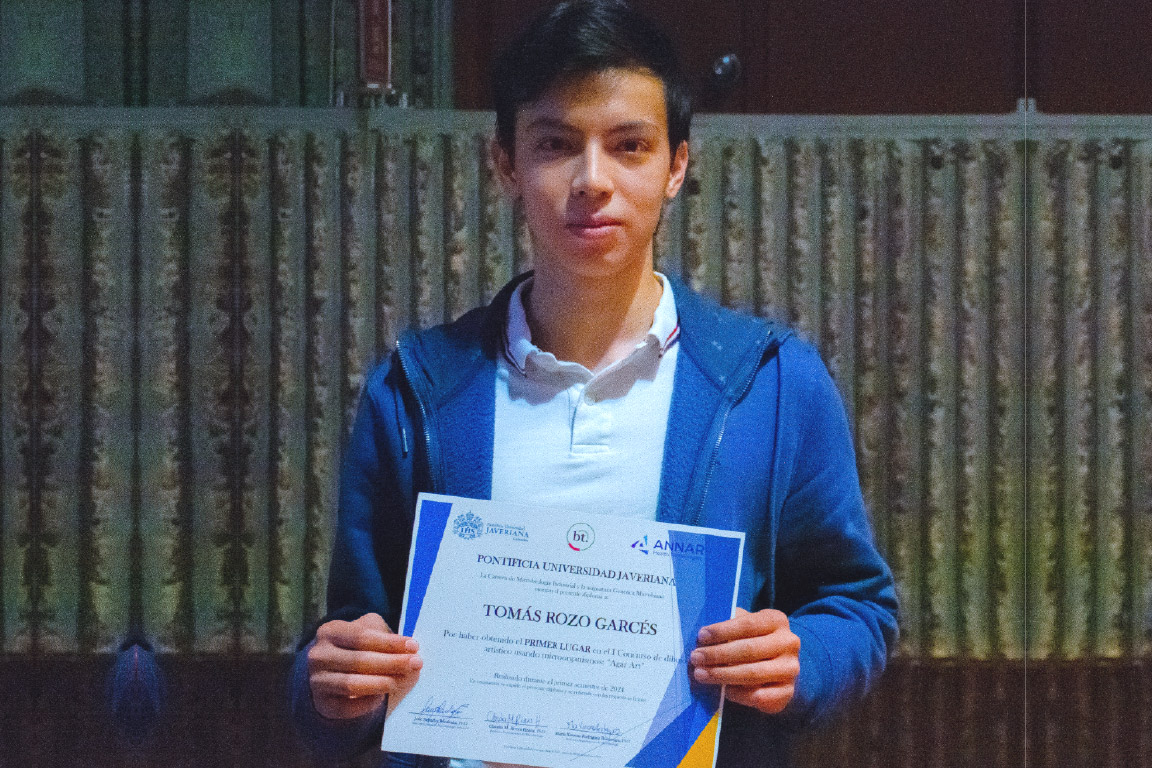
In Vitro News had the opportunity to be present at this first version of Agar Art, where we spoke with Tomás Rozo Garcés, a 19 year old young man from Bogota, a 4th semester student of Industrial Microbiology at the Pontificia Universidad Javeriana, passionate about science and adventure, who was the winner of this first version of Agar Art 2024.

Tomás Rozo Garcés – Winner Agar Art 2024
Tomás What do you dream of in the future?
For the future, I aspire to continue my professional training in another country and to stay and live abroad. I hope to expand my mind, get to know new cultures, learn a new language and develop professionally in an international environment. My goal is to grow both personally and professionally while making a significant contribution to my field of expertise.
What is the purpose of a microbiologist and what motivated you to study this career?
I have always liked biology, my mom is a forestry engineer and since I was a child, she instilled in me the curiosity to understand the background of things. I was not satisfied with what the books said, I wanted to understand the why of the why, that’s what led me to this career.
The role of a microbiologist is crucial today, as we live in the age of microbiology. Many of today’s problems are solved by microorganisms. As a microbiologist, we have a responsibility to address these challenges and find innovative solutions.
Tomás, what do you think is the future of microbiology in Colombia??
The future of microbiology in Colombia is promising but challenging. As science advances and technology becomes more accessible, microbiology is expected to play a crucial role in a variety of fields, from health to agriculture to the environment. However, the country faces challenges in terms of investment in research and development, as well as in the training of highly qualified professionals. Overcoming these barriers requires a continued commitment from government and industry to foster innovation and sustainable growth in this vital field.
What do you think about using art to communicate science?
The use of art to communicate science is a powerful strategy that can make complex concepts more accessible and understandable to a wider audience. Art has the ability to arouse emotions and create connections to scientific knowledge, which can be instrumental in inspiring interest and understanding in scientific topics. In addition, art can provide unique and creative perspectives on science.

Winning work Agar Art 2024
Share with us what inspired you to develop the winning artwork at Agar Art?
I was inspired by the duality between the immensity of the cosmos and the microcosm. I wanted to show the beauty and complexity of microcosms on tiny scales, highlighting how life flourishes even in the smallest corners. My goal was to open people’s eyes to these microscopic universes, using the moon to convey this connection between the macro and the micro in the universe.
How do you create an artwork in agar/ Is it difficult or dangerous and what was the biggest challenge in this experience?
It is quite easy, it is a matter of drawing on the agar, which is like a gelatin, but more solid. It does not represent any danger, although we handle bacteria, these are not pathogenic. It is essential to know the basis of which bacteria generate a specific color due to their metabolism, to know why it happens, the result that will be obtained, as well as it is also vital to properly choose the agar to be used in order to make a drawing.

Tomás, after this rapprochement of science and art, how far do you think it is possible to innovate with the connection of these two worlds?
I believe that the connection between science and art offers a field for innovation. We can expect advances in areas such as science communication, education and research. For example, we could see the development of new forms of scientific data visualization using artistic techniques to make information more accessible and attractive to the general public.
How do you project the future of Agar Art?
I believe that the future of Agar Art is very promising and will continue to grow in popularity and relevance. With the encouragement of professionals such as professors Claudia Rivera and María Ximena Rodríguez, who promote the implementation of these new methodologies to get out of the conventional, the contest will continue to attract more participants and spectators interested in the connection between art and science.

Pilar Carreño – Tomás Rozo – Edwin Pabón
Tell us in what ways do you think this type of activities can be promoted more?
These activities can be promoted through the creation of educational channels and events that encourage collaboration between scientists and artists, thus fostering creativity. In addition, it is important to disseminate information about these initiatives through social networks, media and networks of the university itself, events to publicize the microbiology career along with activities that encourage inventiveness.

Participating works Agar Art 2024
Tomás, before concluding, what do you recommend for future participants?
For future participants, I would recommend exploring and experimenting with different techniques and materials, as well as studying and understanding the basic principles of microbiology. Seek inspiration from new works to develop a unique and creative style. Also, don’t be afraid to take risks and think outside the box, as innovation is key in this type of activity.

Dr. María Ximena Rodríguez, Patricio Ortega, Luis David Gómez, Dra. Claudia Rivera, Tomás Rozo, Pilar Carreño, Edwin Pabón and Dr. Luis David Gómez.
Tomas, congratulations for this achievement and for the interesting vision you have of science and art as a microbiologist. Thank you for this space you have given us, we hope to see you defending this title at Agar Art 2025.